


Piano Safari – Piano Theory Book 3
Piano Safari Theory Book 3 is an 84-page theory workbook for Level 3 of the Piano Safari method, for students ages 6 to 11 (SKU PSTheory3). It goes unit by unit with Repertoire Book 3 and Technique Book 3.
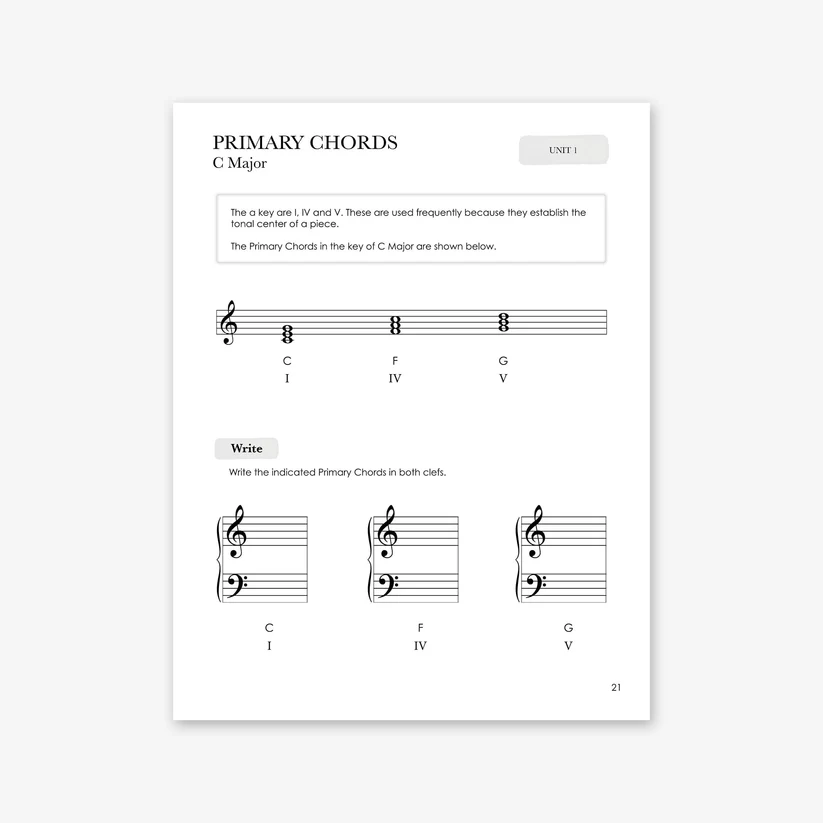
Theory Books 1 and 2 taught students to read what’s on the page. Book 3 teaches why the music sounds the way it does. Students label chords by letter name and by Roman numeral, learn the three main chords of each key, and see how they line up in a progression. Then each unit ends with a harmonization page, where the student picks chords to go under a melody. It’s a first real look at how composers build music, and it gives students a reason for the scales and chords they’re practicing in Technique Book 3.
Who is this book for?
Publisher level: Level 3, listed by Piano Safari as Late Elementary.
Approximate student level: Late Elementary to Early Intermediate.
It’s for students working in Piano Safari Repertoire Book 3. Piano Safari’s guide notes that the book opens by reviewing concepts from the end of Level 2, so students coming from Theory Book 2 should feel at home. It works in lessons or as homework.
What’s inside Piano Safari Theory Book 3?
| Unit | Topics |
|---|---|
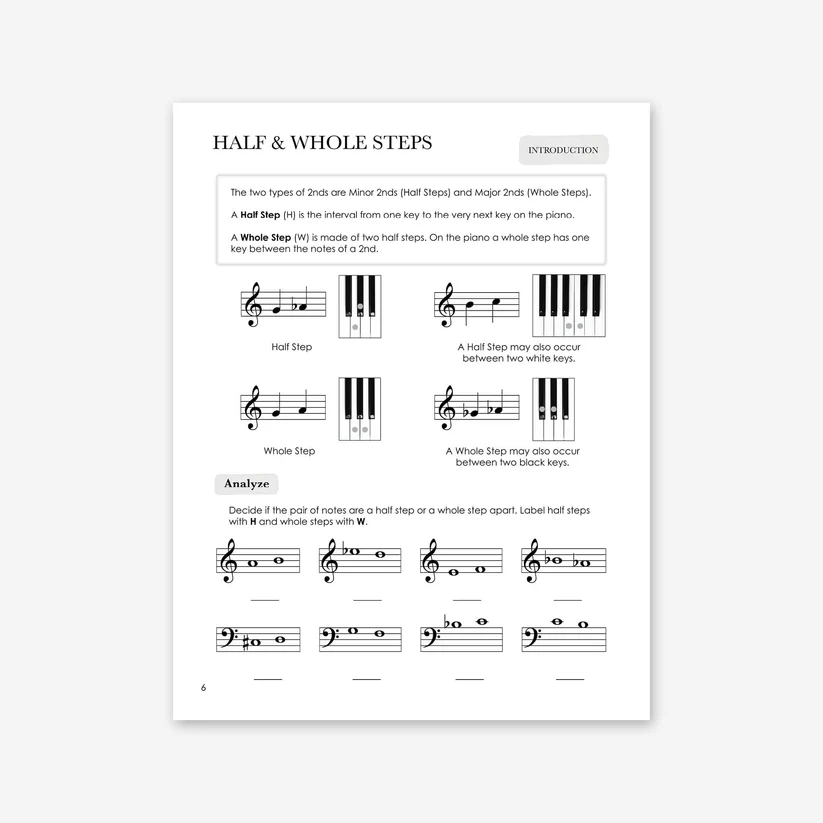
| Introductory | Review: intervals (2nds, 4ths, 6ths), half and whole steps, major and minor pentascales; major, minor, diminished, and augmented triads |
| Unit 1 | C major scales and triads; primary chords; chord inversions; dominant 7th chord; letter-name and Roman numeral analysis; chord progression; harmonization |
| Unit 2 | Intervals from 2nds to 8ths; rests; A minor scales; primary chords; chord progression; harmonization |
| Unit 3 | Sixteenth notes; G major key signature and scale; primary chords; chord progression; harmonization |
| Unit 4 | E minor scales; primary chords; chord progression; harmonization |
| Unit 5 | 6/8 time; F major key signature and scale; primary chords; chord progression; harmonization |
| Unit 6 | D minor scales; primary chords; chord progression; harmonization |
| Unit 7 | Review: C major and A minor, G major and E minor, F major and D minor |
By the end, a student can read and write key signatures for these six keys, name intervals up to the octave, analyze chords with Roman numerals, and harmonize a simple melody using primary chords.
Is Theory Book 3 part of the Level 3 Pack?
No. Piano Safari’s Level 3 Pack is Repertoire Book 3, Technique Book 3, and the Sight Reading & Rhythm Cards 3. Theory Book 3 is extra written practice. At this level, though, it does more than review. Much of Level 3’s chord analysis and harmonizing is taught here, so it’s worth asking your teacher whether they want your child to use it.
Where does Theory Book 3 fit in the series?
It follows Theory Book 2 (SKU PSTheory2). At Level 3 it pairs with Repertoire Book 3 (SKU PSRep3) and Technique Book 3 (SKU PSTech3), all at August Muse. The keys match across all three books, unit for unit.
Product Details
| Field | Detail |
|---|---|
| Title | Piano Safari Theory Book 3 |
| Series | Piano Safari (children’s method), Level 3 |
| Instrument | Piano |
| Product type | Theory workbook |
| Publisher level | Level 3 (Late Elementary) |
| Approximate student level | Late Elementary to Early Intermediate |
| Recommended ages | 6–11 |
| Authors | Katherine Fisher and Julie Knerr Hague |
| Publisher | Piano Safari, LLC |
| Pages | 84 |
| Media | None (no audio tracks) |
| Correlates with | Repertoire Book 3, Technique Book 3, Sight Reading & Rhythm Cards 3 |
| SKU | PSTheory3 |
Frequently asked questions
Does Theory Book 3 teach Roman numerals?
Yes. Letter-name and Roman numeral chord analysis start in Unit 1 and continue in every key.
What does “harmonization” mean here?
Choosing chords to play under a melody. Each of Units 1 through 6 has a harmonization page using that unit’s primary chords.
Which keys are covered?
C major, A minor, G major, E minor, F major, and D minor, the same six keys as Repertoire Book 3 and Technique Book 3.
Best For
- Piano Safari Level 3 students working in Repertoire Book 3
- Students curious about how chords and harmony work
- Kids who want to start playing melodies with their own chords
- Teachers who want written theory tied to the key of each unit
- Laying groundwork for composing and arranging later on
Come page through it in the shop. The harmonization pages are worth a look.
Available at August Muse
Piano Safari Theory Book 3 is available at August Muse in downtown Elizabethton, TN, alongside Repertoire Book 3 and Technique Book 3. Stop in, or call ahead and we’ll hold one for you.

Reviews
There are no reviews yet.