
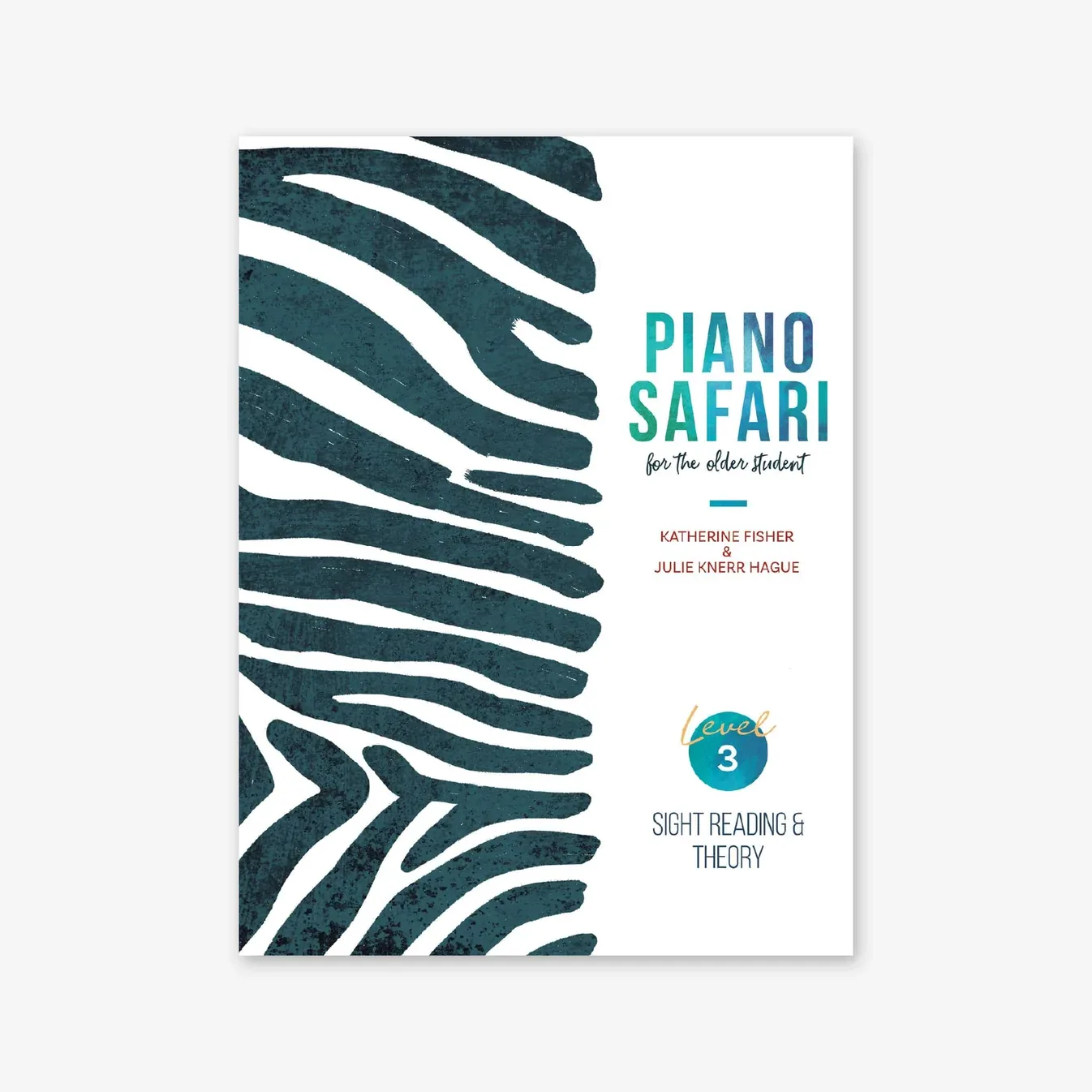
Piano Safari for the Older Student – Piano Sight Reading & Theory Book 3
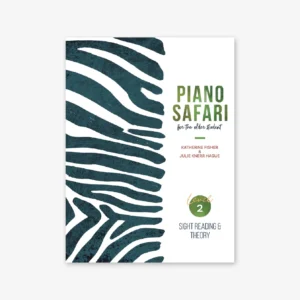
Older Student Sight Reading 3, the Piano Safari Sight Reading & Theory Book 3, is the reading and theory book for Level 3 of the Older Student series (SKU PSOSSR3). It’s 104 pages, organized by the same six keys as Repertoire & Technique Book 3.
Its focus is reading and thinking in keys. Each unit teaches a key’s scale and primary chords (I, IV, V, and V7), has students label chords by letter name and Roman numeral, and builds to a chord progression and a harmonization, where students pick chords to go under a melody. Then come 14 sight-reading examples in that key. Each one starts with analysis questions about the key, meter, and pattern, so students know what they’re looking at before they play.
One feature that’s especially handy for adult learners: an appendix with solutions to the harmonization exercises, so you can check your choices between lessons.
Who is this book for?
Publisher level: Older Student Level 3, listed by Piano Safari as Late Elementary.
Approximate student level: Late Elementary to Early Intermediate.
It’s for teens and adults who have finished Older Student Sight Reading & Theory Book 2. Piano Safari’s Level 3 Teacher Guide says this book can also stand on its own as a reading and theory book, which makes it useful for older students working from other materials, too.
What’s inside Older Student Sight Reading 3?
| Unit | Key | Theory topics |
|---|---|---|
| Unit 1 | C major | Triplet review; scale and primary chords; letter-name and Roman numeral analysis; chord progression; harmonization |
| Unit 2 | A minor | Three forms of the minor scale; primary chords; chord progression; harmonization |
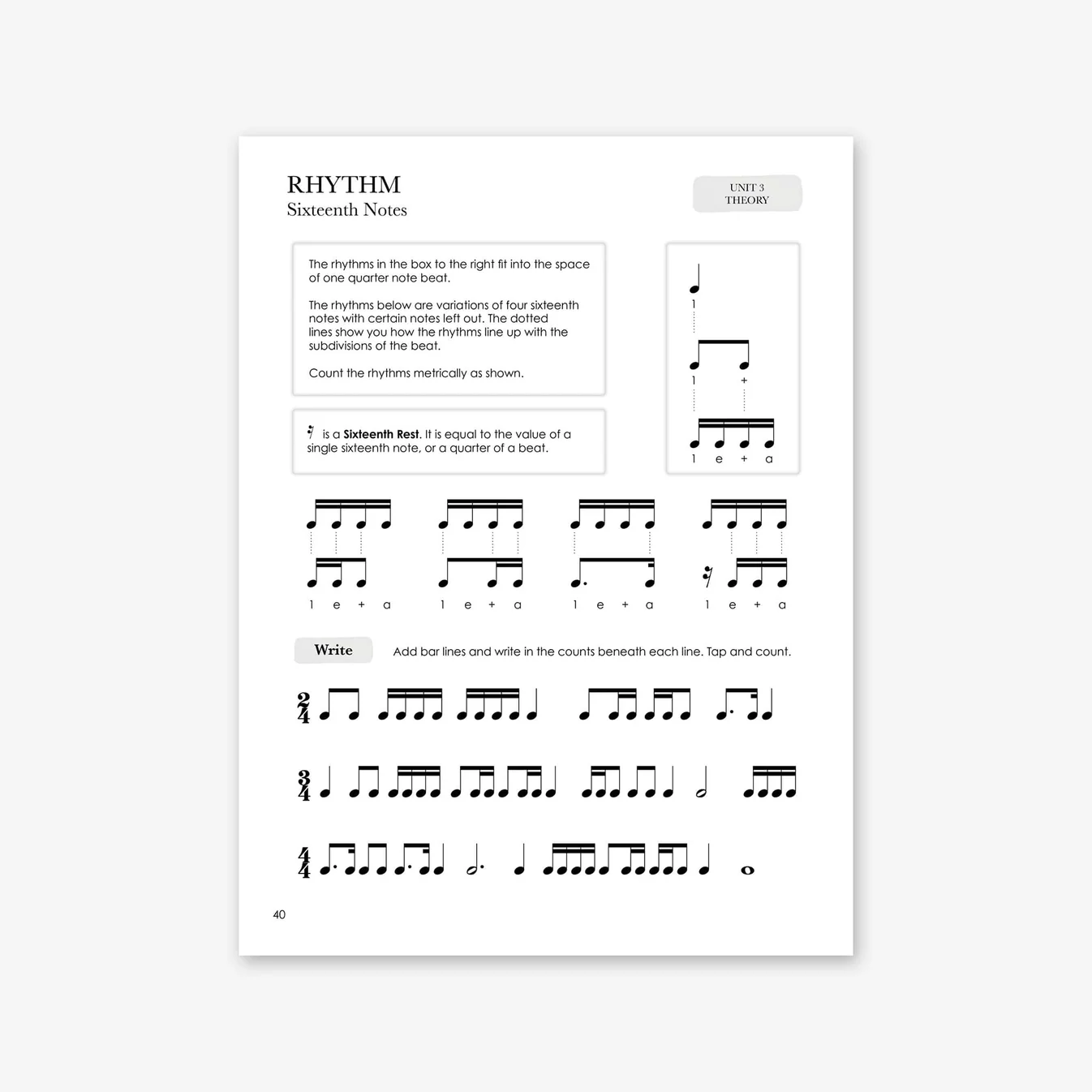
| Unit 3 | G major | Sixteenth notes; scale and primary chords; chord progression |
| Unit 4 | E minor | Three minor scale forms; primary chords; chord progression; G major and E minor harmonization |
| Unit 5 | F major | 6/8 and 3/8 time; scale and primary chords; chord progression |
| Unit 6 | D minor | Three minor scale forms; primary chords; chord progression; F major and D minor composition |
| Unit 7 | All keys | Summary of scales and chords; reading summary |
The sight-reading examples, 14 per unit and 98 in all, cover scales and inversions, melodies over Alberti, waltz, stride, and broken-chord bass, chorale-style chords, and two-part counterpoint. Rhythm tapping exercises are included too.
How are the sight-reading exercises practiced?
Answer the analysis questions first. Then play each part of the example, checking off each correct repetition until it’s been done three times. The rhythm exercises can be tapped, played on two notes, played on a drum, or used for improvising.
Do I need the Repertoire & Technique Book too?
For the full Level 3 course, the two books work together, with matching keys. The pieces and technique are in Repertoire & Technique Book 3 (SKU PSOSRep3). Unlike Levels 1 and 2, though, Piano Safari says this book can stand alone. We sell them separately at August Muse.
Where does it fit in the series?
It follows Older Student Sight Reading & Theory Book 2 (SKU PSOSSR2) and is the final sight reading and theory book in the Older Student series.
Product Details
| Field | Detail |
|---|---|
| Title | Piano Safari for the Older Student: Sight Reading & Theory Book 3 |
| Series | Piano Safari for the Older Student, Level 3 |
| Instrument | Piano |
| Product type | Sight-reading and theory book |
| Publisher level | Older Student Level 3 (Late Elementary) |
| Approximate student level | Late Elementary to Early Intermediate |
| Recommended ages | 12 and up |
| Authors | Julie Knerr Hague and Katherine Fisher |
| Publisher | Piano Safari, LLC |
| Pages | 104 |
| Contents | 7 units; 98 sight-reading examples; theory pages; harmonization solutions appendix |
| Keys | C major, A minor, G major, E minor, F major, D minor |
| Media | None (no audio tracks) |
| Companion book | Repertoire & Technique Book 3 (PSOSRep3), sold separately |
| SKU | PSOSSR3 |
Frequently asked questions
Does it include answers?
Yes, for the harmonization exercises. They’re in an appendix at the back.
Does it teach Roman numeral analysis?
Yes, starting in Unit 1 and used in every key after that. Minor chords are written in lowercase numerals.
Can I use it without the Repertoire & Technique Book?
Piano Safari’s Level 3 Teacher Guide says it can stand alone, though it’s built to match that book’s keys.
Best For
- Teens and adults in Piano Safari Older Student Level 3
- Older students who want to understand chords and harmony
- Adult learners who like checking their own work
- Building reading fluency in six common keys
- Teachers wanting a key-based reading and theory book
Keep a pencil handy. The analysis and harmonization pages are meant to be written in.
Come look through both Level 3 books in the shop.
Available at August Muse
Piano Safari for the Older Student: Sight Reading & Theory Book 3 is available at August Muse in downtown Elizabethton, TN, along with Repertoire & Technique Book 3. Stop in, or call ahead and we’ll set one aside.
Reviews
There are no reviews yet.